
Some of the links on this website are affiliate links. This means that if you click on a link and make a purchase, I may receive a small commission at no additional cost to you. I only recommend products and services that I truly believe in and have used personally or have thoroughly researched.
What really works, which ingredients matter, and where tallow balm fits in.
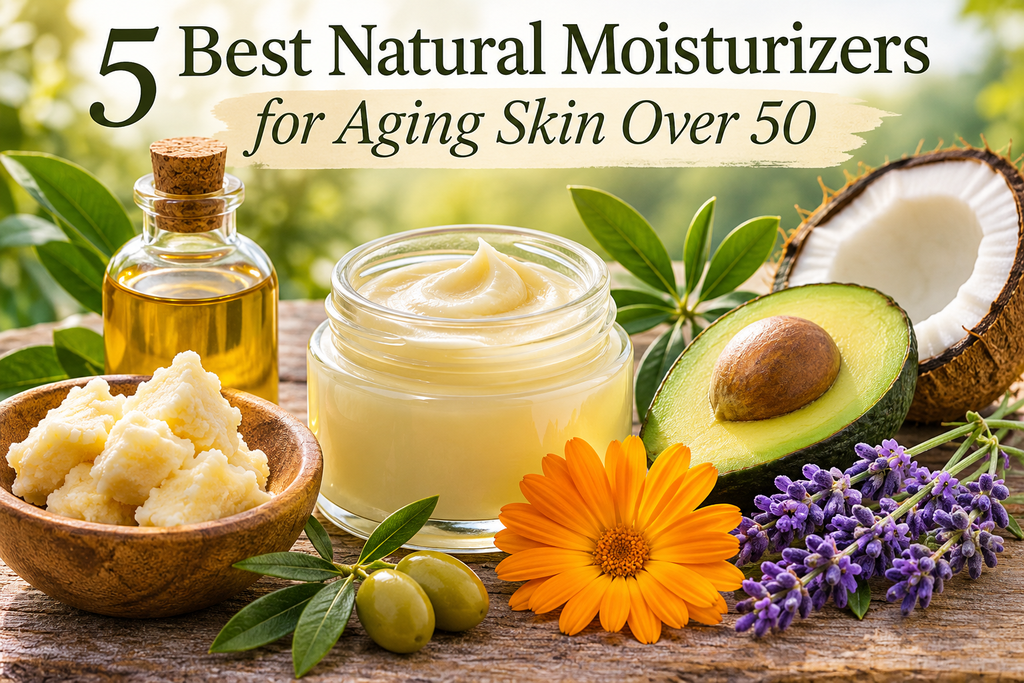
Have you noticed how your skin changes as the years go by?
Perhaps it feels drier than it used to, or those fine lines become more noticeable when your skin needs moisture.
I’ve become increasingly interested in how natural ingredients can support mature skin, particularly simple oils and balms that have been used for generations.
If you’re over 50 and searching for the best natural moisturizers for aging skin, let’s explore five interesting options, what makes each one different, and how to choose the right one for your skin.
Why Does Skin Become Drier After 50?
Our skin changes as we age. Natural oil production may decrease, the protective skin barrier becomes less efficient, and moisture can escape more easily.
Hormonal changes can also influence skin hydration, particularly during and after menopause. Men experience age-related changes in skin structure and moisture retention too.
The result? Skin that may feel tighter, rougher, or less supple than it once did.
Understanding how moisturizers work makes choosing one much easier.
Some ingredients help attract water into the skin. Others soften the surface or form a protective layer that slows moisture loss.
Many natural oils and butters are especially useful for those last two functions.
Here are five worth exploring.
1. Beef Tallow Balm: Traditional Nourishment for Mature Skin
Beef tallow has become one of the most talked-about ingredients in natural skincare, although its cosmetic use has a much longer history.
Tallow is rendered animal fat containing fatty acids such as oleic, palmitic, and stearic acids. These compounds give it emollient properties, helping soften the skin and limit moisture loss.
What interests me about tallow is its simplicity and its potential as a rich moisturizer.
Although scientific research on tallow-based facial skincare is still developing, its fatty-acid composition helps explain why it may be useful for dry skin.
My Experience With F-Balm
One product I’ve personally enjoyed is F-Balm from The Tallowed Truth.
I’ve tried quite a few natural skincare products over the years, and F-Balm genuinely surprised me. Its light texture was the last thing I expected from a tallow-based balm.
There’s growing interest in tallow skincare among people concerned about dryness, acne, and visible signs of aging. However, we don’t yet have adequate clinical evidence to conclude that tallow treats acne or reverses wrinkles. Results can vary with the formulation and individual skin type.
I’ve written a separate article sharing my experience with F-Balm, what makes it interesting, and why I recommend it.
Best for: People who enjoy a nourishing balm and want to explore traditional animal-derived skincare ingredients.
2. Shea Butter: A Botanical Favourite for Dry Skin
Shea butter comes from the nuts of the African shea tree and has been used in skincare for generations.
Its naturally occurring fatty acids help soften the skin and reduce moisture loss.
It has a wonderfully rich texture, making it especially appealing for areas that become rough or dry, such as elbows, hands, and legs.
Shea butter also contains smaller quantities of naturally occurring compounds that have attracted scientific interest for their possible effects on the skin.
One reason I like shea butter as a natural skincare ingredient is its versatility. It can be used on its own or incorporated into richer formulations with botanical oils.
Best for: Very dry skin and rough areas that benefit from a protective, buttery moisturizer.
3. Jojoba Oil: Lightweight Moisture Without the Heavy Feel
Jojoba oil is particularly interesting because, technically, it isn’t an oil at all.
It’s a liquid wax derived from the seeds of the jojoba plant.
Its composition gives it a smooth, silky feel that makes it popular in facial skincare.
Jojoba helps soften the skin and reduce moisture loss, although it doesn’t supply water to the skin by itself.
For someone who prefers a lighter texture, jojoba can be an appealing alternative to heavier butters.
A few drops may be sufficient, particularly when applied to slightly damp skin.
Best for: Those who enjoy lightweight botanical oils and prefer a less buttery finish.
4. Plant-Derived Squalane: Silky, Simple Skincare
Squalane is another fascinating moisturizing ingredient.
It’s a stable form of a lipid related to compounds naturally present in human sebum, the oily substance produced by our skin.
Squalane used in cosmetics can come from plant sources such as olives and sugarcane.
One of its most attractive qualities is its texture. It spreads easily and often feels lighter than richer oils or butters.
It works primarily as an emollient, helping skin feel smoother and more supple.
Squalane is also relatively stable, making it useful in simple facial skincare formulations.
Best for: People who want a lightweight moisturizing ingredient with a smooth finish.
5. Sunflower Seed Oil: Supporting the Skin’s Natural Barrier
Sunflower seed oil deserves more attention than it usually receives.
Rich in fatty acids, particularly linoleic acid in high-linoleic varieties, sunflower oil has been investigated for its effects on the skin barrier.
Research suggests that certain sunflower seed oil formulations may help maintain the outer skin barrier and reduce moisture loss.
The type of sunflower oil matters because fatty-acid composition varies between varieties.
I find this ingredient especially interesting because it illustrates how something familiar and relatively simple can have meaningful applications in skincare.
Best for: Those seeking a botanical emollient that can be incorporated into a gentle moisturizing routine.
Which of the Best Natural Moisturizers for Aging Skin Is Right for You?
The best choice depends on how dry your skin feels, the texture you enjoy, and how your skin responds to particular ingredients.
Here’s a simple comparison:
| Natural Ingredient | Texture | Main Benefit |
|---|---|---|
| Beef tallow balm | Varies by formulation | Softens skin and limits moisture loss |
| Shea butter | Rich and buttery | Protects and softens very dry areas |
| Jojoba oil | Light and silky | Smooths and softens without a heavy feel |
| Plant-derived squalane | Lightweight and smooth | Improves skin softness and suppleness |
| Sunflower seed oil | Light to medium | Helps support the skin’s protective barrier |
One useful principle to remember is that oils and balms primarily help soften skin and retain moisture. They don’t necessarily provide the same hydration as a formulation containing water-attracting ingredients.
For best results, many people find that applying an appropriate moisturizer to slightly damp skin helps maintain a more comfortable level of hydration.
And remember, individual ingredients can sometimes cause irritation or allergic reactions, even when they’re natural.
Frequently Asked Questions About Natural Moisturizers for Mature Skin
What is the best natural moisturizer for skin over 50?
There isn’t one universally best choice. Beef tallow balm and shea butter may appeal to people who enjoy rich, protective moisturizers, while jojoba and squalane offer lighter textures. Your skin’s needs and individual response matter most.
Is beef tallow good for aging skin?
Tallow contains fatty acids with useful emollient properties. It may help soften dry skin and reduce moisture loss, although research has not yet established that it offers special anti-aging benefits.
Can natural oils and balms reduce the appearance of wrinkles?
Moisturizing can temporarily make fine lines associated with dryness less noticeable. However, oils and balms haven’t been shown to reverse deeper wrinkles or restore lost collagen.
Why does my skin seem much drier after menopause?
Hormonal changes, including declining estrogen, can affect skin structure, hydration, and oil production. These changes may contribute to dryness and a less supple appearance.
Can I use a natural moisturizer every day?
Many people use natural moisturizers daily. The important consideration is choosing a formulation your skin tolerates well and adjusting how much you use according to your needs.
Is a rich balm always better for very dry skin?
Not necessarily. A rich balm can help limit moisture loss, but hydration also depends on the condition of your skin barrier and the presence of water-attracting ingredients. Texture alone doesn’t determine how effective a moisturizer will be.
My Final Thoughts
As I’ve explored natural health over the years, I’ve become increasingly interested in the usefulness of simple ingredients.
Skincare is a particularly interesting example.
Our skin is a living, protective organ, and maintaining its natural barrier becomes increasingly important as we age.
Whether you prefer the richness of shea butter, the silky texture of jojoba, or the nourishing feel of a well-formulated tallow balm, the goal is to find something your skin genuinely enjoys.
For me, F-Balm has been a particularly pleasant discovery.
If you’re curious about beef tallow skincare, I’ve written a more detailed review describing my experience and why I recommend it.
Discover My F-Balm Review and Where to Find It
Black Friday Special: Save Up to 50% Through November 28!
If you’ve been thinking about trying F-Balm, this could be a good opportunity.
The Tallowed Truth is offering special Black Friday bundle savings on eligible products.
Purchase four or more eligible products and save 50%. For a regularly priced $49 F-Balm, that brings the price down to $24.50 each, before shipping.
Smaller qualifying orders offer savings too:
- One product: 20% off
- Two products: 30% off
- Three products: 40% off
- Four or more products: 50% off
The sale ends November 28, 2026.
Explore The Tallowed Truth Black Friday Sale
Research and Further Reading
For readers interested in the science behind skin aging and natural moisturizing ingredients:
- American Academy of Dermatology: How to Care for Your Skin in Your 60s and 70s
- Vegetable Butters and Oils as Therapeutically and Cosmetically Active Ingredients for Dermal Use: Review of Clinical Studies
- Natural Oils for Skin-Barrier Repair: Scientific Review
- Tallow, Rendered Animal Fat, and Its Biocompatibility With Skin: Scoping Review
- Tufts University School of Medicine: What’s the Deal With Beef Tallow?
This article is for educational purposes and does not replace individualized medical or dermatological advice.